Advance Use I


|
Advance Use I |
|
|
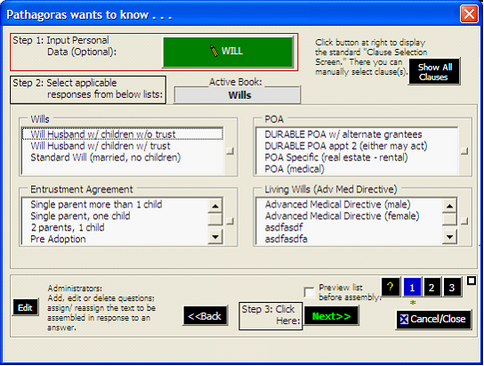
As you become more familiar with Pathagoras, you might decide to build the source clauses in such a way that it asks your questions at assembly time (using <<*Optional*>> text blocks). That will greatly simplify what you put into the Q & A interview form. While there are several ways to accomplish this in Pathagoras, a clause that ready works might look like this: I am [married/not married] and I have <<*Options*no children/one child whose name is [Name of Child(ren)]/two children whose names are [Name of Child(ren)]/three children whose names are [Name of Child(ren)]/four children whose names are [Name of Child(ren)]>> In the above example, when the document is assembled, the end-user will be asked to choose the number of children in the family. And when the Instant Database is called, it will capture the marital status of the client using the bracketed, multiple choice variable “[married/not married]” and the names of the children. You can also use the individual frames of the Q&A Interview to present a series of separate (but topically related) documents (as opposed to not a series of questions that lead to a whole document): Let’s say that you have stored a variety of different documents covering a host of different subjects all in a single folder. (If you elect to use the tree service (discussed below) you can not only draw clauses from the current folder, but from any folder ‘under’ this folder.) Use the Q&A screen to categorize the the various document. If the folder is one containing a variety of letters, assign frame to (let’s say) cover letters to customers, frame 2, cover letters to vendors, frame 3, cover letters to other contacts.
Figure 10. The Final Product (seen by the end-user)
|